[vc_row][vc_column][vc_column_text]
The UK by all accounts appears to be lagging behind other tech leading countries in its corporate adoption of virtual reality. Funding for UK based projects is also behind. New VR orientated trade shows such as the virtual reality show at Islington’s business design centre will hopefully address this. These tradeshows are a place for people in VR related industries to meet up and share ideas and for businesses and individuals to come and try out the technology. The 3 day event showcased applications in use by some of the early adopters of VR and other emerging technologies. Healthcare, retail, gaming, automotive, construction, therapy, marketing, art, theatre and film.
My interest in VR began a couple of years ago with 360 video production. Having been suitably impressed by some of the early 360 documentaries I started exploring how this new language of film making could be applied to my corporate video production work. This has opened up into a more general interest in virtual reality and new immersive media. I find the emerging VR industry to have an exciting freshness that I can imagine was around in the early days of the film industry.
VR in the Medical Industries
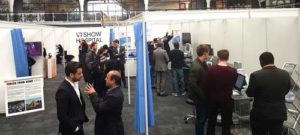 The medical industry had a dedicated section with a diverse selection of training applications. I underwent a 3 minute VR training in Cardiopulmonary resuscitation (CPR), which I apparently did quite well at. I can imagine if I was ever called upon to do that in a future life-threatening situation, this immersive training will probably
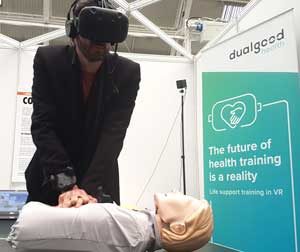 be imprinted on my memory. I tried a few other experiences. A simulation of a specific type of blindness that obscures the central part of your vision. Tools such as this enable therapists and medical professionals to better understand the experience of their patients. The applications of VR in mental health largely been around exposure therapy. Exposing patients to their phobias and traumas in the comfort of a VR headset can safely ease them into their fear c
 onfrontation. I’ve tried quite a few of these and even found a few phobias I didn’t know I had. I tried an interesting experience at the show designed for PTSD afflicted war veterans. Having a bomb explode in my face in a rural Afghani village didn’t have too grave an impact on me though if you’ve been traumatised by such an incident, this might help you let go of it. This capacity for facilitating deep psychological change is for me one of the most fascinating aspects of virtual reality.
Augmented reality/mixed reality/shared immersion
The complete immersiveness of virtual reality to the exclusion of the outside world and other people is something of a drawback in certain situations. Facebook and other social VR platforms are working towards shared experiences using avatars though this is still in the early stages. Microsoft’s mixed reality headset, the hololens was in evidence at some of the stands. Virtual material superimposed on the outside world is finding many useful applications where the user needs to retain contact with the outside. This technology will probably find many more real world applications than VR in the long run. The other form of shared immersion, projects the content onto the inside of a domed screen. Two versions of this were demoed at the show and both allowed for free interactivity between viewers whilst watching the content. Igloo’s system involved a 360° panoramic strip without the top and bottom while Sublime’s version gave a 180° screen including the top and bottom.
360 Video
360 video, while not offering the interactivity of computer generated virtual reality, does open up the possibility of experiencing an almost unlimited variety of real-world experiences within a VR headset. 360 filmmaking, both fiction and documentary is a new breed. I wrote a bit about how this is affecting the video production industry in my write-up of February’s Broadcast Video Expo (BVE). Some content producers are simply importing traditional filmmaking techniques into 360 while others are working on ways of gamifying it into an interactive experience. There was some debate at BVE as to the degree we might take to active participation in filmic storytelling when we have been brought up on a passive story experience. Even without a classic game style interaction, the 360 immersiveness still requires participation in viewing direction.  I’m looking forward to the day when technologies such as lightfield rendering give us some degree of room scale in 360 video. At the show, production company Visualise were demoing a documentary work in progress called ‘The Final Bell’. As well as being beautifully shot (using a stereo pair of Sony A7s DSLRs so I was told) they also combined the footage with some photogrammetry allowing for some room scale freedom of movement. This blending of 360 video with room scale VR is an exciting field that I’m keen to explore more of.
One of the interesting things about this emerging VR industry is that it brings together many different disciplines. Programmers, UX designers, filmmakers, animators, marketers, artists, musicians. Many fields have an interest in the production of VR content and almost every industry has a potential interest in its use. The show hosted a dedicated section for the automotive industry which is using VR for both design and retail. 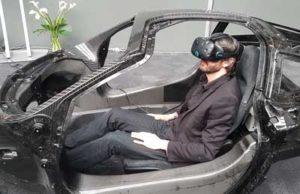 Designers are able to easily see the various iterations of a car design in a realistic environment and potential customers are able to view and even test drive. Marketing and brand awareness using VR is a new field taking inspiration from traditional forms of advertising, branded content and video marketing. George P Johnson marketing agency had a stand at the show and advise clients on particular marketing methods for particular projects. While some projects may require a traditional real-world approach others can benefit from from these emerging technologies.
In these early days of the technology the VR industry seems to have a creative excitement around it. Both content creators and viewers are still finding out what works and where it is used best. This is laying a fertile ground for sharing ideas and collaborating. With good content the whole industry flourishes. The collaboration across many different technical and creative disciplines is helping to make virtual reality a potentially groundbreaking tool and artform.
